Broken Clocks Still Chime: Why Gen Z Producers Are Paying Thousands for Machines Nobody Wanted
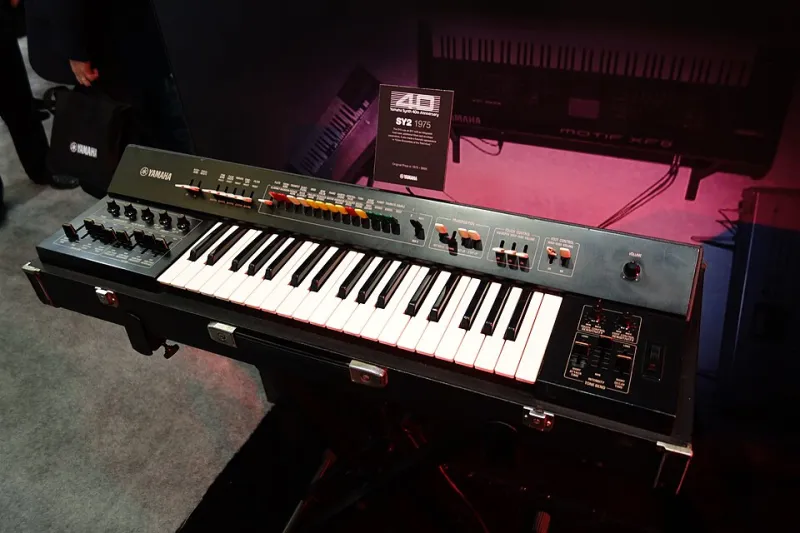
Photo: Pete Brown from Gambrills, MD, USA, CC BY 2.0, via Wikimedia Commons
Somewhere in a garage in Akron or a spare bedroom in East Nashville, a 22-year-old is carefully soldering a capacitor back onto a circuit board that was manufactured before they were born. The machine it belongs to was discontinued, forgotten, and nearly trashed — and right now it's worth more than a used car. Welcome to the synth graveyard revival, where obsolescence is the whole point.
The underground market for discontinued 80s and 90s synthesizers and drum machines has been quietly heating up for years, but lately it's reached something close to fever pitch. We're not just talking about the obvious trophies — your Minimoog, your Roland TB-303, machines that have carried collector status for decades. We're talking about the weird middle tier: the Korg EX-800, the Casio CZ-5000, the Oberheim Matrix-1000, the Yamaha DX21. Machines that got dumped at pawn shops in the early 2000s for forty bucks. Machines that are now moving for fifteen hundred, two grand, sometimes more, on Reverb and eBay and through a network of Discord servers that feel more like secret societies than marketplaces.
So what happened? The short answer is that Gen Z producers found them. The longer answer is way more interesting.
The Sound That Plugins Can't Fake
Ask any producer deep in this world why they're hunting down a Roland Juno-106 instead of just loading up a software emulation, and they'll give you an answer that sounds almost spiritual. "It breathes differently," says one producer from Chicago who asked to stay anonymous because, as he put it, "I don't want more people knowing what I'm looking for." "Every software version sounds technically correct and emotionally dead. The real thing has this weight to it."
This is the core argument, and it's not just nostalgia talking. Analog circuits behave in ways that are genuinely difficult to model perfectly in software. Capacitors age. Oscillators drift slightly out of tune and then back. The voltage-controlled filters that define the sound of an old Moog or Roland unit respond to input in ways that have a warmth — or a weirdness — that digital approximations tend to sand down. When you hear it, especially in a mix, you notice.
But it goes beyond the technical. There's something about working with a machine that has one job, a fixed set of controls, and zero connection to the internet that forces a different kind of creative relationship. You can't pull up a tutorial. You can't undo everything. You have to learn the machine on its own terms, and that constraint — frustrating as it is — tends to produce sounds that are distinctly yours, because you had to fight for them.
The Repair Underground
Here's the thing nobody mentions in the glossy gear-review world: most of these machines are broken. Or partially broken. Or one bad chip away from being a very expensive paperweight.
This is where the repair community becomes the actual beating heart of the revival. Across YouTube, Discord, and forums like Gearslutz and Elektronauts, there's a dense network of technicians, enthusiasts, and outright obsessives who have made it their mission to keep this hardware alive. Some are retired engineers who worked on this stuff when it was new. Some are self-taught kids who got into electronics through curiosity and ended up becoming the only person in their city who knows how to recap a Juno-106 voice chip.
The voice chips are actually a whole crisis unto themselves. Roland's IR3109 and BA662 chips — central to the sound of several iconic machines — haven't been manufactured in decades. When they fail, which they eventually do, you either find a new-old-stock replacement (increasingly rare and expensive), track down a modern clone chip (a cottage industry has grown around exactly this), or your synth becomes a parts donor. The community has responded by developing open-source chip replacements, sharing service manuals that were never meant to be public, and building small businesses around keeping machines alive that corporations wrote off thirty years ago.
There's something deeply punk about it. The manufacturers moved on. The market moved on. And a loose global network of people who just loved the sounds refused to let it die.
Obsolescence as Authenticity
The cultural logic here is worth sitting with, because it says something real about where we are right now.
We live in an era of infinite options. Any producer with a laptop and a decent audio interface has access to thousands of virtual instruments, sample libraries covering every conceivable sound, plugins that can emulate literally anything. The ceiling for production quality, technically speaking, has basically dissolved. You can make a radio-ready track in your bedroom for a few hundred dollars in software.
And somehow, that abundance has made people crave scarcity. Crave limitation. Crave a machine that can only do what it can do, that sounds exactly like itself, that carries four decades of physical history in its knobs and keys.
The "obsolescence as authenticity" framing isn't just a vibe — it's a genuine aesthetic and philosophical stance. When a producer chooses to build a track around a Yamaha DX7's electric piano patch or a Roland TR-707's rim shot, they're not being lazy or nostalgic. They're making a statement about what realness sounds like in an age when everything can be faked perfectly. The imperfection, the specificity, the irreproducibility — that's the whole point.
The Price of Admission
None of this comes cheap, and that's creating some real tension in the community.
As these machines have become desirable again, prices have climbed to levels that make them inaccessible to a lot of the younger producers who are most drawn to them. A Roland Juno-106 that sold for $200 at a Chicago estate sale in 2015 might list for $1,800 today. The Oberheim OB-8, once a fixture of church basements and storage units, can move for $4,000 or more depending on condition. The Roland Jupiter-8 — forget it, we're talking mortgage money.
Some producers are pushing back by leaning into the even-weirder, even-more-obscure tier: the machines that haven't been rediscovered yet, the Japanese market-only releases, the budget consumer gear that turns out to have genuinely strange and useful circuits inside. It's a constant frontier-pushing, a race to find sounds that haven't been claimed yet.
Others are building their own. The Eurorack modular synthesis community has exploded partly as a response to vintage hardware prices — you can assemble a system that does genuinely wild things for a fraction of what a clean Juno costs, and the DIY culture around it shares DNA with the repair underground.
The Frequency Nobody Abandoned
What ties all of this together is a refusal to accept that newer automatically means better. That's not a new idea, obviously — people have been saying it about records and film cameras and tube amps forever. But there's something particular about the way Gen Z has embraced it, because this generation grew up entirely inside the digital world. They're not retreating to analog out of ignorance of what software can do. They know exactly what it can do. They've used it. And they're choosing the old machine anyway.
The synth graveyard isn't a graveyard anymore. It's a frequency that never stopped broadcasting. You just had to know where to tune in.