Paid Premium for Broken: Why Gen Z Producers Are Dropping Serious Cash on Gear That Doesn't Work Right
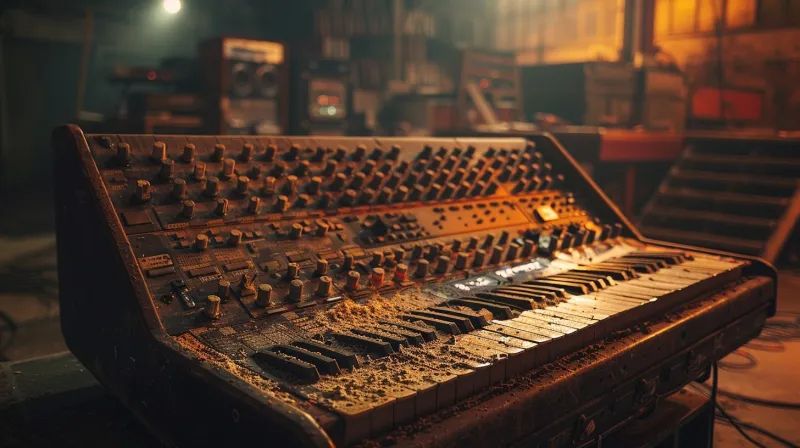
Photo: vintage synthesizer broken dusty analog hardware studio, via images.stockcake.com
There's a Roland SH-101 sitting in a storage unit in Burbank right now. One of its oscillators drifts unpredictably, somewhere between a quarter-tone flat and a pitch that doesn't technically have a name. The seller listed it as "for parts or repair" and priced it accordingly — low, apologetic, almost embarrassed. It sold in eleven minutes for nearly double the asking price. The buyer, a 24-year-old producer from Atlanta who goes by the handle Gravel Mouth online, wasn't interested in fixing it. He was interested in that drift. He'd been chasing that exact kind of instability for two years through plugins, and nothing came close.
"Software gives you a simulation of broken," he explained over DMs. "Hardware that's actually broken gives you something you can't predict. That's the difference between a photograph of fire and actual fire."
This is the logic driving one of the stranger economic micro-trends in contemporary music culture: a thriving underground market for malfunctioning vintage gear, where the defects aren't disclosed reluctantly — they're advertised as selling points.
The Glitch Is the Product
For a long time, the vintage synthesizer market operated on pretty traditional collector logic. Condition mattered. Functionality was king. A pristine Minimoog with all original components and a working pitch wheel commanded a premium. A unit that crackled or dropped notes was a project piece — discounted, passed over, destined for someone patient enough to track down a technician.
That calculus has started to flip, at least in certain corners of the market.
Producers — particularly younger ones who grew up in an era of infinite, frictionless digital tools — are increasingly seeking out gear with specific, repeatable malfunctions. A drum machine where the hi-hat channel randomly doubles. A vintage Casio with a dying battery circuit that makes the envelope controls behave like they're drunk. A Juno that hums at exactly 60Hz because its power supply is shot. These aren't bugs to be patched. They're signatures.
The reasoning is almost philosophical. When every producer on the planet has access to the same VST library, the same sample packs, the same pristine emulations of vintage gear, differentiation becomes almost impossible through technical means alone. But a specific broken piece of hardware? That's a sound no one else has. That's irreplicable by definition.
Where the Market Lives
This trade doesn't happen on Guitar Center's used gear wall. It lives in Discord servers with vetting processes, in Facebook groups with names that sound like experimental bands, in the back channels of Reverb.com where sellers have learned to describe malfunctions with the specificity of wine notes. "Oscillator 2 has a warm, irregular drift that becomes more pronounced after 20 minutes of warm-up." That's not a warning. That's a feature description.
There are also physical nodes — certain record fairs and synth swap meets, particularly in cities like Chicago, Los Angeles, and Brooklyn, have developed informal reputations as places where broken gear gets properly valued. Sellers who know their audience have started skipping the usual apologies. They lead with the malfunction.
Prices reflect the shift. Gear that would have moved for parts money five years ago now clears four figures if the defect is interesting enough and the seller knows how to describe it. A Korg Monotron with a dying filter chip isn't worth $40 anymore if someone can demonstrate that the dying chip creates a specific kind of harmonic saturation that no intact unit produces. Suddenly that's worth $200 to the right buyer.
Authenticity as a Scarcity Model
What's happening here connects to something broader in how Gen Z thinks about creative tools and authenticity. There's a deep suspicion of perfection — not just aesthetic perfection, but the kind of frictionless, infinitely correctable experience that defines most modern software. Undo culture, to borrow a phrase, has made everything feel provisional. Nothing commits. Nothing decays. Nothing surprises you.
Broken hardware commits. It surprises you constantly, and not always in ways you asked for. A malfunctioning sequencer that randomly skips steps isn't a reliable creative partner, but it's an honest one — it has its own behavior, its own character, and it will impose that character on your music whether you like it or not. That loss of control, paradoxically, is exactly what some producers are paying premium prices to experience.
There's also a community dimension to this. Producers who work with specific broken units end up developing intimate knowledge of those units' peculiarities. They learn what temperatures make the drift worse, what sequences trigger the glitch, how to coax the malfunction into something musical rather than just chaotic. That knowledge is non-transferable. It's a skill set that belongs exclusively to that relationship between that producer and that specific piece of dying hardware. In an era where every technique is a YouTube tutorial away, that kind of private, hard-won expertise carries genuine cultural weight.
The Ethics of the Graveyard
Not everyone in the vintage synth world is thrilled about this. Traditionalist collectors — the people who've spent decades preserving and restoring vintage gear — watch this trend with a mixture of bemusement and frustration. There's a real concern that broken units are being snatched up before technicians can restore them, that the fetishization of malfunction is accelerating the decay of irreplaceable instruments.
It's a fair tension. A 1973 ARP 2600 with a failing voice card is a historical artifact, and there's something genuinely uncomfortable about treating its decline as an aesthetic asset rather than a conservation problem. The synth graveyard economy doesn't have a clean answer to that critique.
What it does have is a counter-argument about use. These instruments were built to make music. A pristine, museum-quality unit sitting behind glass isn't making music. A unit with a weird oscillator issue that a producer in Phoenix has built three albums around — that instrument is alive in a different sense. Imperfect, deteriorating, unrepeatable, but alive.
Decay as Creative Frequency
Maybe the most interesting thing about this whole economy is what it says about where creative value actually lives in 2025. Not in fidelity. Not in accuracy. Not in the faithful reproduction of some ideal, pristine sound. It lives in specificity, in irreproducibility, in the texture of things that are wearing out.
There's something almost poetic about a generation that inherited a digital landscape of infinite, perfect copies turning around and paying good money for things that are visibly, audibly falling apart. It's not nostalgia exactly — most of these producers have no memory of these instruments in their prime. It's more like a deliberate bet against perfection. A choice to work with material that has its own agenda, its own timeline, its own slow collapse.
The synth graveyard economy isn't really about vintage gear. It's about finding a frequency that nobody else is broadcasting on — even if that frequency is a dying oscillator drifting somewhere between a note and a feeling.