Dead Signal, Full Shelves: The Gen Z Kids Collecting Radios They'll Never Actually Turn On
There's a Zenith Trans-Oceanic shortwave receiver sitting on a shelf in a Portland apartment, positioned between a succulent and a dog-eared copy of Simulacra and Simulation. Its owner, a 24-year-old graphic designer named Mara, has never successfully received a broadcast on it. She has also never particularly tried.
"It just exists the way I want things to exist," she says, running a thumb along the chrome dial. "It has weight. It has a purpose it can't fulfill anymore. That feels really honest right now."
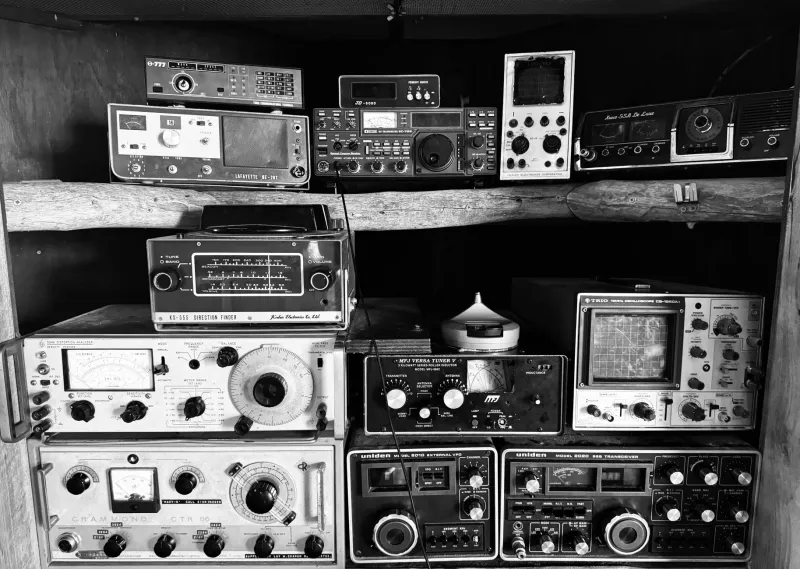
Mara is not alone. Across flea markets, estate sales, eBay rabbit holes, and increasingly dedicated Discord servers, a generation of collectors is quietly stockpiling vintage radio equipment — shortwave receivers, ham radio transceivers, tube-powered cathedral sets, Cold War-era military surplus gear — with little to no intention of ever tuning in to anything. The radios sit. They look incredible. And that, apparently, is the whole point.
The Aesthetics of Abandoned Infrastructure
To understand why a 22-year-old in Columbus, Ohio is dropping $200 on a Hallicrafters SX-28 that needs a complete recap job, you have to understand what these objects communicate just by existing in a room.
Vintage radio equipment is, in purely visual terms, extraordinary. Analog dials with hand-painted frequency bands. Bakelite knobs worn smooth by decades of fingers. Vacuum tubes glowing amber behind mesh grilles. The physical language of these machines is one of consequence — the idea that tuning a signal was once a deliberate, effortful, almost ceremonial act.
That contrast with contemporary consumption is doing a lot of heavy lifting for this collector community. When your entire music library lives in a server farm somewhere in Virginia and arrives in your earbuds without friction, the idea of a device that required skill, patience, and atmospheric cooperation to receive a single broadcast becomes almost radical.
"Streaming is frictionless by design," says Derek, a 26-year-old in Chicago who runs a small blog documenting his growing collection of ham radio equipment. "And frictionless is another word for weightless. These radios have weight. Literal weight. You can't ghost them."
Dead Media as Philosophy
The academic framework for this kind of collecting has been around for a while — media theorist Wolfgang Schivelbusch wrote about the nostalgia for obsolete technologies back in the '80s, and cultural critics have long tracked how dead media gets absorbed into aesthetic movements. But what's happening with this particular Gen Z cohort feels different from nostalgia in the traditional sense.
Nostalgia implies longing for an experience you had, or at least one your cultural lineage had. Most of these collectors were born well after shortwave radio's golden age. They didn't grow up listening to Radio Moscow or Voice of America crackling through a family set in the living room. They came to these objects cold, through thrift store encounters and YouTube rabbit holes about Cold War espionage and numbers stations.
What they're expressing isn't grief for a lost experience. It's more like a philosophical position about the nature of objects and meaning. A radio that can no longer receive broadcasts has been freed from its original function. It becomes purely itself — a sculpture of intention, a fossil of a communication system that once believed it was connecting the world.
"There's something really beautiful about an object that tried to do something enormous and now just... doesn't," says Yolanda, a 23-year-old in Atlanta who specializes in collecting Soviet-era shortwave receivers. "It's not sad. It's like it graduated."
The Community Frequencies
The collector community has coalesced in predictable Gen Z fashion — Discord servers, niche subreddits, Instagram accounts with five hundred followers and the energy of something that matters deeply to the people in the room. There's genuine expertise being traded: which capacitors to replace if you want a set to actually glow without catching fire, which eBay sellers are trustworthy, which flea markets in which cities are still worth hitting on a Saturday morning.
But there's also a philosophical conversation happening alongside the technical one. Posts asking whether it's "wrong" to restore a set to working order when the silence is part of the appeal. Debates about whether displaying a radio next to modern equipment is ironic or sincere. Arguments about whether buying a $900 Collins S-Line transceiver is materialism dressed up as anti-materialism.
That last question — the self-aware one — is maybe the most interesting thing about this community. They're not naive about the contradiction of consuming vintage objects as a rejection of consumption culture. They're sitting with the contradiction, turning it over, deciding it's worth the discomfort.
What the Silence Sounds Like
Mara turns the Zenith's dial slowly, not looking for a signal, just feeling the resistance of the mechanism. The pointer sweeps across frequencies that once carried news from Havana, religious programming from Quito, numbers read in flat Cold War monotone from somewhere nobody was supposed to identify.
None of that comes through now. What comes through is static, if she turns it on at all, which she often doesn't.
"People think it's sad," she says. "But I think it's more like — this thing held space for all of those voices. And now it holds a different kind of space. For me, in my apartment, in 2024, where everything is instant and nothing has a body."
The Zenith doesn't respond. It sits there, chrome and Bakelite and decades of atmospheric memory, doing the only thing it can do now.
It looks like it means something. In this particular moment in American culture, that might be enough.