One Room, No Features: The Artists Making Music Like Nobody Else Is Allowed In
The feature economy is booming. Scroll through any new release on any major streaming platform and you'll find a landscape built on collaboration — producers co-signed by bigger names, vocalists stacked three deep on a single track, remix packages that arrive before the original has finished charting. Modern music culture is networked almost by definition. The assumption is that more connections mean more reach, more reach means more listeners, more listeners mean more legitimacy.
Some artists have decided they want nothing to do with any of that.
Not because they're bitter. Not because nobody asked. Because isolation, it turns out, is a creative choice — and a pretty radical one in 2024.
The Collaboration Industrial Complex
It's worth understanding just how thoroughly collaboration has been normalized in contemporary music production before you can appreciate how strange it is to reject it. The modern music ecosystem runs on features, co-writes, producer credits, and remix culture. Even artists who project an image of solitary genius are usually working with a team of writers, producers, and engineers whose names appear in the fine print.
This isn't inherently cynical. Collaboration produces genuinely great work. It always has. The problem is when it stops being a creative choice and becomes a structural requirement — when you're collaborating not because the music demands it but because the algorithm rewards it, because a feature from a larger artist is a distribution strategy as much as a creative one, because the remix culture means your music is only finished when someone else has touched it.
That's the version of collaboration that some artists are pushing back against. Not the spirit of it. The machinery.
What Radical Isolation Actually Sounds Like
The music coming out of this counter-movement is genuinely hard to categorize, which might be the point. When you remove the social and economic pressures that shape mainstream production choices, you end up with work that doesn't sound like it's trying to fit anywhere.
Some of it is dense and interior — long-form pieces that feel more like diary entries than songs, built around instrumental textures and voice memo fragments and sounds recorded in the artist's immediate physical environment. Some of it is almost confrontationally simple, stripped down to a single instrument and a vocal recorded in one take with no processing, because the artist decided that was exactly what the song needed and didn't need anyone else's opinion on it.
What these records share is a quality that's genuinely hard to manufacture: the feeling that you're hearing exactly what one person wanted to make, with no negotiation, no compromise, no external input. It's uncomfortable sometimes. It's also often the most honest music being made right now.
The Refusal as Statement
There's a growing number of artists — mostly operating in the indie, experimental, and DIY spaces — who are being deliberately explicit about their isolation as a creative stance. Not just making music alone, but saying so. Including notes in their liner copy about the fact that no collaborators were involved. Turning down remix requests publicly. Declining features not because they're uninterested in the artists asking but because they've decided the work is finished and doesn't need to be extended.
This reads as almost confrontational in a music culture that treats networking as neutral and collaboration as inherently virtuous. It raises uncomfortable questions: What does it mean to make something that doesn't want to be remixed? What does it mean to release music that isn't trying to expand its own reach through someone else's audience? What are you actually saying when you decide your art is complete without anyone else's input?
For some of these artists, the answer is something pretty simple: I made this for myself, and I'm letting you hear it, and that's the whole transaction. Take it or leave it.
The Long Tradition of Staying Home
It's worth noting that this isn't actually new. The history of music is full of artists who worked in deep isolation — not as a brand strategy but as a genuine psychological and creative necessity. Brian Wilson building Pet Sounds in a sandbox in his living room while the rest of the Beach Boys toured. Arthur Russell recording hundreds of hours of solo material that he never released and never finished, because the finishing wasn't the point. Scott Walker disappearing for years between records, returning with work that sounded like it had been made on another planet.
What's different now is the context. Those artists were isolated partly by circumstance, partly by temperament. The artists choosing isolation in 2024 are doing it against a backdrop where collaboration is easier and more incentivized than it has ever been. You can co-produce a track with someone in Tokyo from your apartment in Cincinnati without leaving your chair. The tools for networked creation are everywhere. Choosing not to use them is a statement in a way it simply wasn't before.
What Gets Made in the Quiet
Here's what the isolation actually produces, practically speaking: music that takes risks nobody would approve. When you're working alone, there's no collaborator to tell you the bridge is too long, the mix is too weird, the concept is too niche. There's no feature artist whose audience you're trying not to alienate. There's no producer whose aesthetic preferences are quietly shaping your choices.
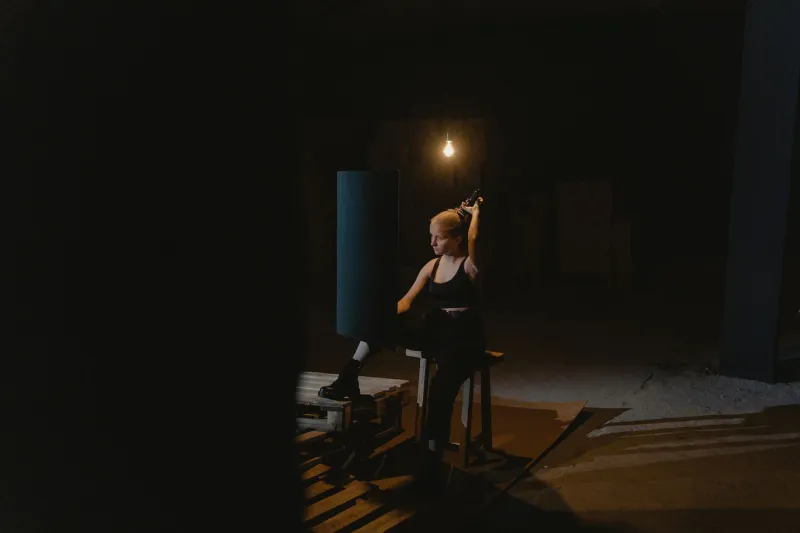
There's just you, the room, and whatever you actually think the song needs.
That can produce self-indulgent garbage. It can also produce the most singular, irreducible creative work of a generation. The difference is whether the isolation is a discipline or an excuse — and the artists doing this seriously know the difference.
The music that comes out of a room where nobody else was allowed in carries something specific. A fingerprint. A refusal to be smoothed out. In a landscape of optimized, networked, endlessly collaborative content, that fingerprint is increasingly rare.
And increasingly worth finding.